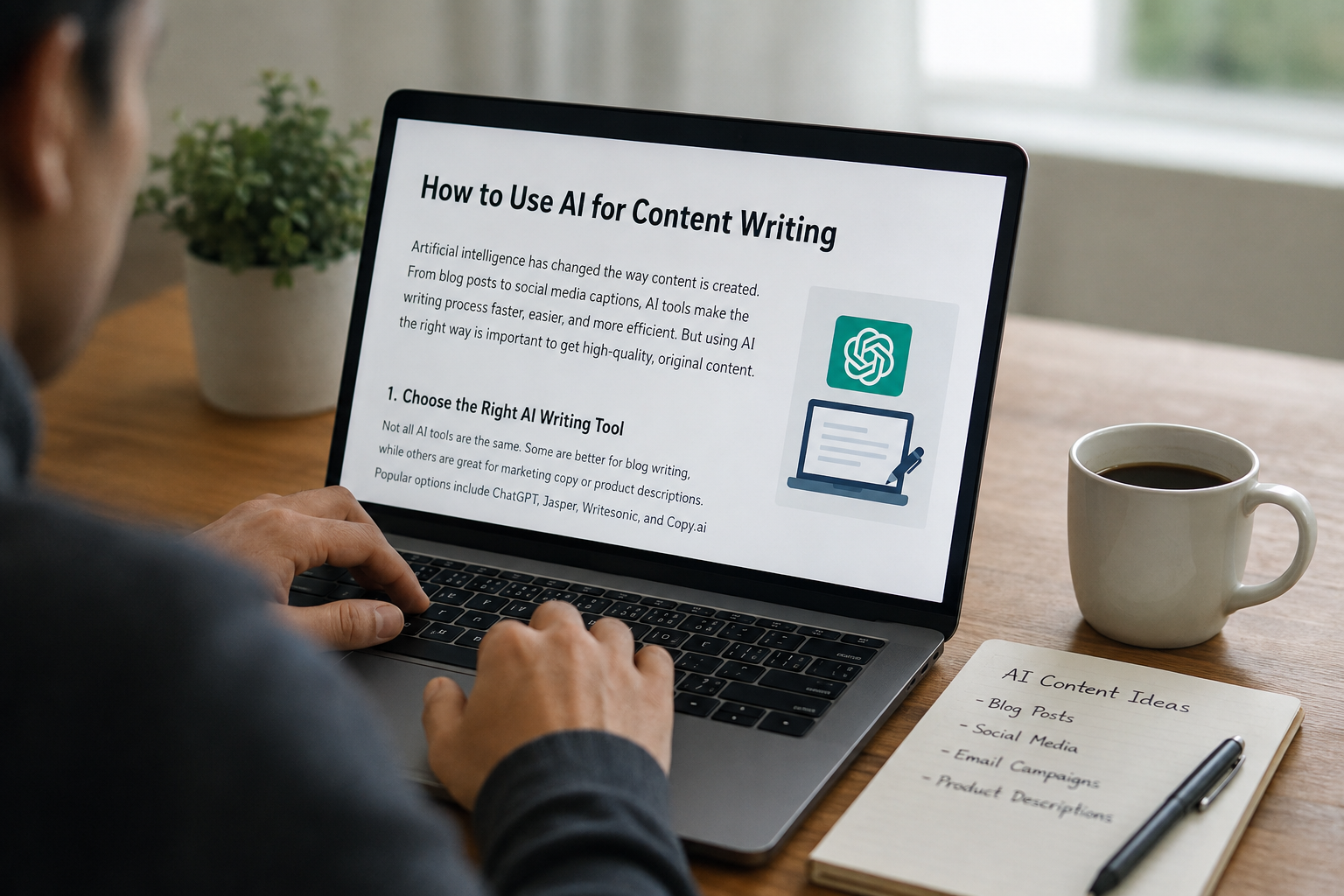
Content writing has changed a lot over the last few years. What once took hours of research and editing can now be completed much faster with the help of artificial intelligence. However, many people still think AI can replace human writers completely. That is not true. The best results come when AI and human creativity work together.
If you are wondering how to use AI for content writing, this guide will help you understand the right approach. Whether you are a blogger, freelancer, business owner, or digital marketer, AI can improve your writing process without sacrificing quality.
What Is AI Content Writing?
AI content writing is the process of using artificial intelligence tools to help create written content. These tools understand language patterns and can generate articles, blog posts, product descriptions, social media captions, emails, and much more.
Instead of writing every sentence from scratch, you can use AI to generate ideas, create outlines, write drafts, and improve grammar. The final content still needs human editing to make it natural, engaging, and trustworthy.
The goal is not to let AI do everything. The goal is to use AI as a writing assistant that saves time while allowing you to focus on creativity and originality.
Why AI Is Becoming Popular for Content Writing
More writers are using AI because it speeds up the writing process and removes many common obstacles.
Some of the biggest benefits include:
- Faster content creation
- Better idea generation
- Improved grammar and spelling
- Easier keyword optimization
- Consistent writing style
- Reduced writer’s block
Instead of spending hours staring at a blank page, you can begin with an AI generated outline and build a better article from there.
Choose the Right AI Writing Tool
The first step is selecting a reliable AI writing tool. Different tools are designed for different purposes. Some focus on SEO, while others specialize in creative writing or marketing content.
A good AI writing tool should offer:
- Natural language generation
- Grammar improvement
- Content suggestions
- SEO assistance
- Easy editing options
Remember that even the best AI tool cannot replace your knowledge and experience. It simply makes the writing process smoother.
Start with a Clear Topic
AI performs better when you provide clear instructions.
Instead of writing a prompt like:
“Write about travel.”
Try something more detailed like:
“Write a beginner friendly blog post about budget travel tips for Europe with practical advice and SEO optimization.”
The more specific your instructions are, the better the output becomes.
Create a Detailed Content Outline
Before generating the full article, ask AI to create an outline.
A strong outline usually includes:
Introduction
Main headings
Supporting subheadings
Conclusion
Frequently asked questions
This structure keeps your article organized and improves readability for both readers and search engines.
Let AI Write the First Draft
Once your outline is ready, you can ask AI to write each section.
Avoid generating an entire long article in one prompt. Instead, create one section at a time. This approach gives you better quality and allows you to control the flow of information.
For example, generate the introduction first, then each heading individually.
This method also reduces repetitive content.
Add Your Personal Experience
One mistake many beginners make is publishing AI generated content without making any changes.
Readers can easily recognize generic writing.
Instead, add your own:
Personal opinions
Real experiences
Practical examples
Case studies
Lessons learned
These elements make your article unique and build trust with readers.
For example, if you have personally used AI for writing blog posts, explain how it improved your workflow or helped you save time.
Personal insights make your content stand out from thousands of similar articles.
Edit Every AI Generated Paragraph
AI can make mistakes.
It may include outdated information, incorrect facts, repetitive phrases, or awkward wording.
Always review every paragraph carefully.
During editing, check for:
Grammar errors
Fact accuracy
Natural sentence flow
Keyword placement
Readability
Logical structure
Editing transforms average AI content into high quality human friendly content.
Optimize for SEO
One of the biggest advantages of AI is helping with search engine optimization.
When writing SEO articles, include your main keyword naturally throughout the content.
For this article, the primary keyword is:
How to Use AI for Content Writing
Place it in:
The title
Introduction
Headings
Body paragraphs
Conclusion
Do not overuse the keyword because keyword stuffing can harm rankings.
Also include related keywords naturally such as:
AI writing tools
AI content creation
Artificial intelligence writing
SEO content writing
AI blog writing
Content writing tips
These related terms help search engines understand your topic.
Make the Content Easy to Read
Readers prefer simple and clear writing.
Use:
Short paragraphs
Simple vocabulary
Clear headings
Logical flow
Conversational tone
Avoid complicated words unless they are necessary.
Writing like you are talking to a friend keeps readers engaged until the end.
Check for Originality
Although AI generates new text, it is still important to verify originality.
Use plagiarism checking tools before publishing.
If any sentences seem too common or repetitive, rewrite them in your own words.
Original content performs better in search engines and builds credibility with your audience.
Fact Check Everything
AI does not always provide accurate information.
Before publishing, verify:
Statistics
Research findings
Dates
Product information
Industry updates
Never assume every AI generated statement is correct.
Accurate content earns reader trust and reduces misinformation.
Improve the Introduction
The introduction determines whether readers continue reading.
A strong introduction should:
Identify the problem
Explain why it matters
Promise a useful solution
Keep readers interested
Instead of writing generic introductions, create one that immediately connects with your audience.
Write Natural Headlines
Headlines play an important role in SEO and reader engagement.
Good headings are:
Clear
Simple
Keyword focused
Benefit driven
For example:
How to Use AI for Content Writing
Benefits of AI Content Writing
Best AI Writing Practices
Common AI Writing Mistakes
These headings help both readers and search engines understand your article.
Avoid Depending Completely on AI
AI should support your writing process rather than replace it.
Human writers provide:
Emotion
Creativity
Critical thinking
Personal perspective
Original storytelling
These qualities cannot be fully replicated by artificial intelligence.
The best articles combine AI efficiency with human expertise.
Common Mistakes to Avoid
Many beginners misuse AI when creating content.
Here are some mistakes to avoid.
Publishing without editing.
Using the same prompts repeatedly.
Ignoring SEO optimization.
Adding too many keywords.
Not checking facts.
Copying AI content exactly as generated.
Writing without understanding the topic.
Avoiding these mistakes can significantly improve the quality of your articles.
Best Practices for AI Content Writing
To get the best results, follow these simple practices.
Research the topic before using AI.
Create a detailed outline.
Generate content section by section.
Edit every paragraph.
Add personal insights.
Optimize naturally for SEO.
Check grammar carefully.
Verify facts before publishing.
Maintain your own writing style.
Focus on helping readers instead of simply filling words.
Following these steps consistently will help you create professional content that performs well in search engines.
Can Google Detect AI Content?
This is one of the most common questions among bloggers.
Google has repeatedly stated that it focuses on content quality, not whether content was written with AI assistance.
If your article is:
Helpful
Original
Accurate
Well researched
Written for people
Then it has the opportunity to rank well regardless of whether AI assisted in the writing process.
Poor quality content will struggle whether it is written by AI or a human.
The Future of AI Content Writing
Artificial intelligence will continue improving every year.
Future AI tools will likely become better at understanding context, user intent, and natural language.
However, human creativity will remain valuable.
Readers enjoy authentic stories, real experiences, honest opinions, and practical advice.
Successful writers will be those who learn how to combine AI efficiency with human creativity.
Instead of competing against AI, they will use it as a powerful productivity tool.
Final Thoughts
Learning how to use AI for content writing is becoming an essential skill for bloggers, marketers, freelancers, and business owners. AI can save time, generate ideas, improve productivity, and help optimize content for search engines. At the same time, it should never replace your own creativity, experience, and judgment.
The most successful content is created when AI handles repetitive tasks while you focus on adding value, sharing personal insights, and connecting with readers. Always edit carefully, verify facts, optimize naturally for SEO, and write with your audience in mind.
If you use AI wisely, it can become one of the most valuable tools in your content writing workflow. The goal is not to let artificial intelligence write for you. The goal is to use it to write smarter, faster, and better while keeping your unique voice at the center of every article.